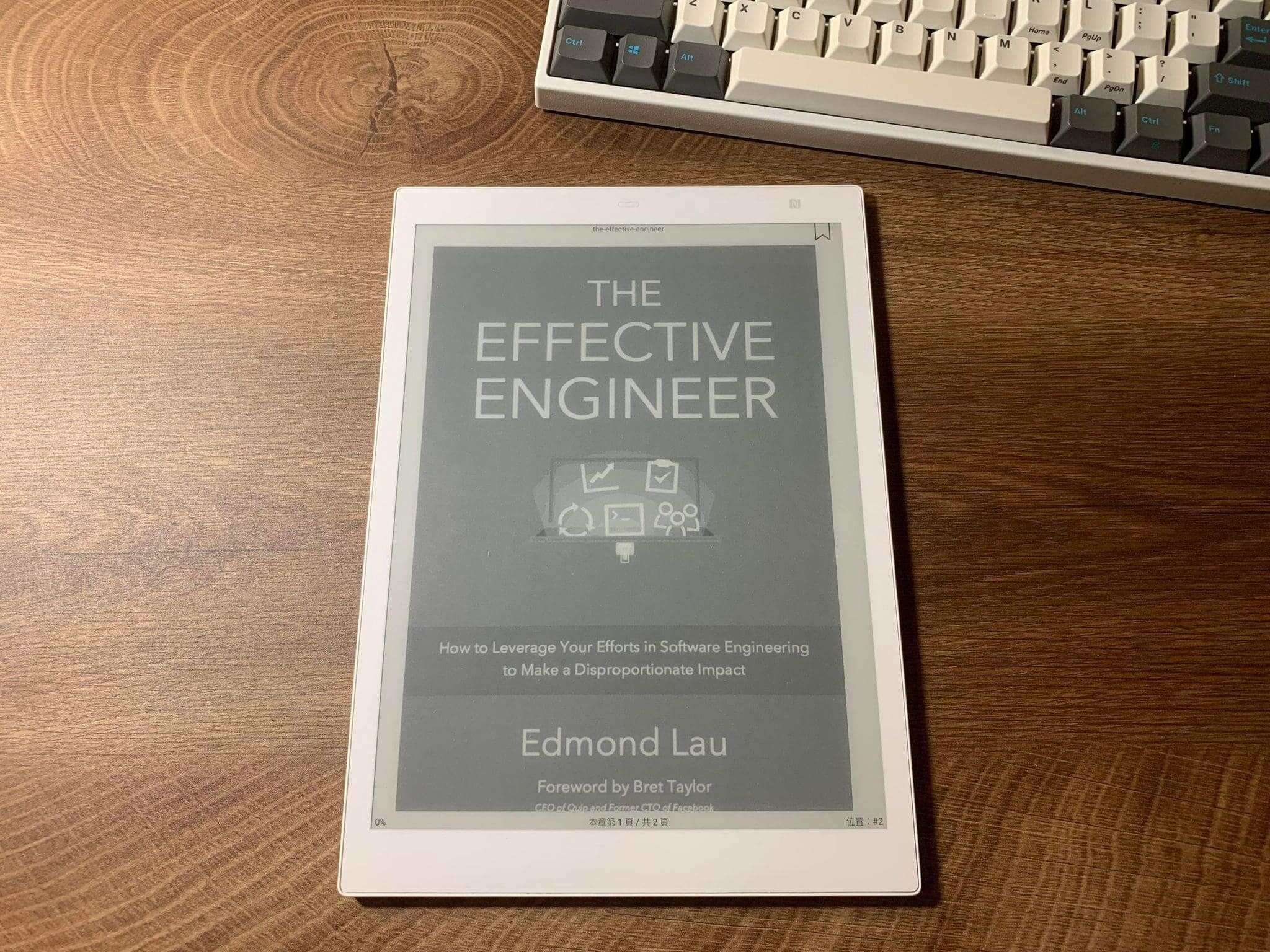
The Effective Engineer by Edmond Lau: A Guide to Maximizing Your Impact in Silicon Valley
2023年5月11日
The Struggle is Real
It's evening, and you're staring at increasingly abstract code in VSCode while Terminal throws error messages at you. Then Slack pings with an urgent bug that needs fixing. Before you know it, another hour has vanished. It's already past quitting time, yet you've barely made a dent in today's work. You can't help but sigh—working feels like climbing a mountain, and the descent is harder than the climb.
Have you ever been in a phase where work never ends? Tasks pile up, and by Friday you're staying until nearly midnight. Self-doubt creeps in: Is your technical skill lacking? Are you inefficient? Or is there just too much work?
Recently, several tech blogs recommended The Effective Engineer, praising it highly. I decided to dive in, hoping to become an effective engineer myself.
I started with the author's talk at Google, which covers the book's main ideas. This article summarizes the key points from that talk. I'll write a separate post once I finish the book.
About the Author
Edmond Lau has worked at major Silicon Valley companies like Google and startups like Quora. He once worked 80+ hours per week for two consecutive years, then spent another two years researching what makes an effective engineer.
He interviewed CTOs and technical leaders from 20+ Silicon Valley tech giants and startups (Facebook, Instagram, Dropbox, Etsy, etc.), asking three questions:
- What separates the most effective engineers you've worked with from everyone else?
- What's the most valuable lesson you've learned in the past year?
- What investment in your team has yielded the highest returns?
From these interviews, he distilled efficiency practices all software engineers can learn—what he calls the leverage framework.
The Core Concept: Leverage
This book contains no code. Instead, it teaches how to maximize your impact by executing high-leverage activities, amplifying your value and influence.
The author presents a harsh truth:
effort === impact // False
Effort doesn't equal impact and contribution.
A staff engineer's output might be 10 times that of a junior engineer, but their hours aren't 10 times longer.
The book's core concept is leverage—a multiplier that converts effort into enormous value and impact, and the fulcrum for breaking free from daily development drudgery. Here's the formula:
leverage = impactProduced / timeInvested
Engineering work follows the 80/20 rule: 20% of tasks create 80% of value, while 80% of tasks produce only 20% of results.
Identify tasks that take minimal time but create maximum value and impact, and prioritize them. These are called high-leverage activities.
The talk covers five types of high-leverage activities:
1. Optimize for Learning
Maximize your learning ability—learning compounds!
Because learning has compound effects, your growth curve is exponential: flat at first, then nearly vertical after a critical point. This makes sense: solving hard problems requires accumulating knowledge from different angles, and once connected, the solution emerges.
The classic example: improve 1% daily, and you'll improve 37x in a year.
Everyone knows learning matters, but the challenge is being buried in daily development tasks and bug fixes. How do you find time to learn?
Google implemented 20% Time: one day per week for non-core work—researching new tech, pursuing passion projects. Gmail came from 20% Time.
For regular employees, the author suggests: reserve one hour daily for your own 20% Time.
One final tip: start with topics you're interested in or problems you face at work, because motivation is the most important element for sustaining action.
2. Invest in Iteration Speed
Accelerate repetitive tasks. It's like deciding whether to write code as a function: when you do something twice, automate the third time.
When the author asked CTOs what makes effective engineers different, they answered: "Engineers who invest time in automation tools are always the most efficient."
This includes everything from shell scripts to full CI/CD infrastructure.
At Quora, the author deployed 40-50 times daily. Without CI/CD automation, that would consume enormous time.
Major Silicon Valley companies have dedicated teams building internal tools—Facebook created React.js. The author says: "We all want to author the next trendy framework, but we can start with our daily development work!"
3. Validate Your Ideas Aggressively and Iteratively
Verify feature feasibility before implementation to avoid wasting time and resources.
Etsy redesigned their search results page with infinite scroll. A/B testing showed click-through and conversion rates dropped 10% and 25% respectively. The feature never shipped—months of wasted effort.
After this, Etsy adopted a progressive approach: break features into verifiable assumptions, confirm they help the product, then develop.
The author emphasizes: execute uncertain, risky things first to avoid wasted effort later.
4. Minimize Operational Burden
Reduce daily maintenance costs by focusing on complexity.
When Facebook acquired Instagram, it served 40 million users with just 13 employees—only 5 engineers. By any measure, an incredibly efficient team.
Asked what made this possible, the CTO answered: "We use the simplest approach to solve problems. Engineers question each other to ensure no added maintenance burden before developing."
Complexity cascades:
code complexity → system complexity → product complexity → organization complexity
Complex code increases engineer comprehension and communication costs. System complexity increases maintenance costs. Product complexity makes future features harder. Organizational complexity impacts team efficiency.
The author once vacationed in Hawaii when a system only he understood broke. With no internet on the volcano, he became a single point of failure.
He then prioritized mentorship: detailed onboarding docs and processes. Engineers who once needed three months to understand the codebase now contribute to production in their first week. Massive efficiency gain!
5. Building a Great Engineering Culture
Create a good development team culture. Engineers want to work in good environments. Focusing on leverage activities creates a positive cycle, making efficiency increasingly smooth.
Q&A
Q: Writing tests is necessary but time-consuming. Any more efficient testing methods?
A: Ensure critical paths have test coverage to prevent regressions during frequent changes.
You don't need 100% test coverage. Testing rarely-used areas can be wasteful.
Q: Your examples are startups or small companies. How do you reduce complexity in large companies?
A: Startups benefit from direct communication, but large companies have advantages like historical data.
Google is highly data-driven, so let data speak and influence decision-makers to pursue leverage activities.